Tarten Planc: The Rustic Welsh Tart Cooked on a Griddle
Some pies demand an oven, a special dish and a suspicious amount of kitchen equipment. Tarten Planc is having none of that. This old Welsh treat takes pastry, fills it with fruit and cooks the whole thing on a hot bakestone or griddle. The result is wonderfully uncomplicated: crisp outside, soft inside and far more interesting than its modest appearance suggests.
The name gives away the method. In North Wales, a bakestone or griddle can be called a planc. Tarten Planc is therefore, quite literally, a tart of the bakestone. It belongs to the same practical Welsh cooking tradition that produced Welsh cakes, where a heavy heated surface did much of the work now entrusted to ovens.
Its precise beginnings are difficult to pin down, which feels entirely appropriate. Foods cooked in ordinary homes rarely arrive with birth certificates. Recipes were passed through families, adapted to whatever fruit was available and often measured by eye rather than scales. One recorded family apple recipe describes exactly that tradition: the grandmother simply judged the ingredients, and later generations continued making her tart.
Historically, the bakestone was an important piece of Welsh kitchen equipment. Before reliable domestic ovens became commonplace, a heated stone or iron plate provided a remarkably versatile cooking surface. Bread, oatcakes, pancakes and Welsh cakes could all be prepared on it. Naturally, someone eventually realised that pastry and fruit could join the party.
That cooking method is what makes Tarten Planc unusual. A conventional fruit pie receives heat from all around inside an oven. Here, however, the pastry sits directly against the hot surface. It develops toasted patches and a slightly firmer character while the enclosed filling becomes warm and yielding.
Apple is one traditional filling, particularly suited to the larger folded version. The apples are stewed first, sweetened and cooled. They are then enclosed in pastry before the tart is cooked slowly on both sides. It resembles a substantial fruit turnover, although calling it a turnover somehow makes it sound as though it should be sold beside a railway-station coffee.
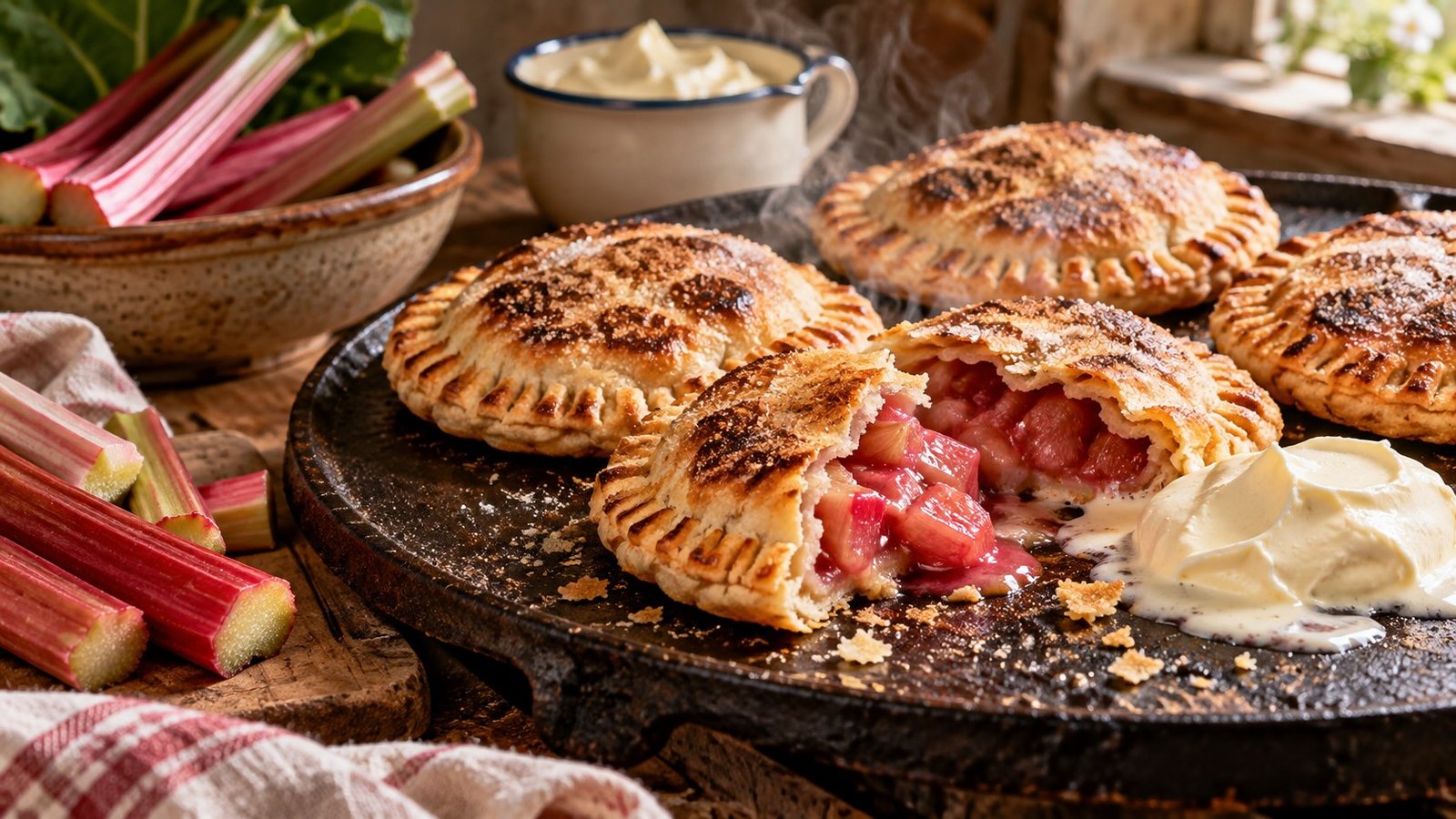
Rhubarb provides another particularly Welsh-feeling interpretation. Small rhubarb Tarten Planc can be made as individual pies, with pastry discs enclosing a sharp, softly cooked filling. Some versions combine rhubarb with honey and orange. Thick cream and brown sugar then turn something admirably rustic into something considerably less austere.
Modern interpretations go further. Blackberries work beautifully, especially when combined with apple. Damsons and plums provide enough acidity to prevent the pastry from becoming cloying. Pear benefits from ginger, while apple welcomes cinnamon, although too much spice can overwhelm the simple character of the tart.
There is also considerable freedom over shape. Large versions can be rolled into an oval, filled on one side and folded like a pasty. Smaller ones may use two pastry circles pressed together around the filling. Neither needs to look geometrically perfect. In fact, excessive precision would probably make Tarten Planc rather nervous.
What makes it special is the contrast between economy and indulgence. The ingredients are ordinary, and the technique requires little equipment. Yet freshly cooked pastry filled with warm fruit is inherently luxurious. Moreover, direct contact with the griddle creates a flavour and texture that oven baking cannot quite reproduce.
The best accompaniment depends on the filling. Apple Tarten Planc practically invites warm custard, particularly on a wet afternoon when optimism has already left the building. Rhubarb is excellent with clotted or thick double cream. Vanilla ice cream also works, although it moves the dish away from its farmhouse character.
For drinks, strong black tea is probably the easiest companion. Assam or a robust breakfast blend can stand up to buttery pastry and sweet fruit. Meanwhile, coffee works better with apple than very sharp rhubarb. A lightly sweet cider makes an excellent alcoholic pairing, especially with apple-filled tarts.
For something richer, try a small glass of dessert wine with a rhubarb version. Welsh whisky can also work after dinner, particularly beside apple, pear or blackberry fillings. However, Tarten Planc was never designed as an exercise in gastronomic choreography. Tea remains entirely respectable.
Other foods can turn it into part of a broader Welsh spread. Bara brith provides a darker, spiced contrast, while Welsh cakes continue the griddle-cooking theme. A piece of mature Caerphilly cheese alongside an apple version creates a surprisingly good sweet-savoury combination. Sharp cheese and cooked apple have been friends for considerably longer than fashionable restaurants would have us believe.
Nutritionally, Tarten Planc has one obvious advantage over many elaborate desserts: you know exactly what is in it. Fruit contributes fibre and useful micronutrients, while apples also provide pectin. Rhubarb offers fibre and relatively few calories before sugar, pastry and cream become involved.
Still, nobody should mistake pastry cooked in butter and lard for a wellness programme. Traditional recipes can contain considerable saturated fat, refined flour and added sugar. Portion size therefore matters more than pretending the dessert has somehow become medicinal because an apple is present.
Fortunately, the recipe is easy to adjust. Butter can replace some or all of the lard. Wholemeal flour can add fibre and a nuttier flavour. Likewise, naturally sweet apples require less added sugar, while tart rhubarb generally needs rather more encouragement.
Finding Tarten Planc outside Wales can be harder than finding Welsh cakes or bara brith. It remains closer to home cooking than commercial baking. Traditional food events, Welsh markets, independent cafés and regional food festivals offer the best chances. Yet the simplest solution is to make it yourself.
That is arguably how Tarten Planc makes most sense anyway. It is not a polished patisserie creation requiring seventeen components and somebody with tweezers. It is domestic food: flour, fat, fruit, heat and patience. The bakestone does the rest.
Traditional Apple Tarten Planc Recipe
This version follows the traditional idea of a large folded apple tart cooked slowly on a bakestone. A heavy cast-iron frying pan or flat griddle works perfectly well if medieval Welsh kitchen equipment is temporarily unavailable.
Makes 2 large tarts, approximately 4–6 servings.
For the pastry:
225g self-raising flour
225g plain flour
115g cold butter, cubed
55g lard, cubed
120–170ml cold water
A pinch of salt
Caster sugar, for finishing
For the apple filling:
600g cooking apples, peeled, cored and sliced
50–60g caster or light brown sugar
2 tablespoons water
½ teaspoon ground cinnamon, optional
1 teaspoon lemon juice
First prepare the filling. Put the apples, sugar, water and lemon juice into a saucepan. Add cinnamon if you want it, although the tart is perfectly happy without it.
Cook gently until the apples soften but still retain some texture. Avoid turning them into a wet purée because excess liquid makes sealing the pastry difficult. Once cooked, leave the mixture to cool completely.
Meanwhile, combine both flours and the salt in a large bowl. Rub in the butter and lard with your fingertips until the mixture resembles coarse breadcrumbs. Add the cold water gradually, mixing until a soft but manageable dough forms.
Do not overwork it. This is farmhouse pastry, not an audition for a French pâtisserie.
Divide the dough into two equal pieces. Roll each piece on a lightly floured surface into an oval roughly 5mm thick.
Place half the cold apple mixture on one side of each oval, leaving a generous border. Lightly dampen the pastry edges with water. Fold the empty half over the filling to produce a large semicircular tart.
Press the edges together firmly. Crimp them with your fingers or a fork to prevent the filling escaping during cooking.
Heat a bakestone, cast-iron griddle or heavy frying pan over low to medium-low heat. Give it plenty of time to heat evenly. The surface should cook the pastry steadily rather than scorch it.
Carefully place the first tart onto the hot surface. Cook for approximately 12–14 minutes, checking underneath occasionally. Once golden brown, carefully turn it using two wide spatulas.
Cook the second side for another 12–14 minutes. The pastry should be deeply golden in places and cooked through. Repeat with the second tart.
Transfer the finished Tarten Planc to a board and sprinkle lightly with caster sugar while still warm. Leave it for a few minutes before cutting because the apple filling will be extremely hot.
Serve warm with custard for the classic comfort-food treatment. Alternatively, add thick cream or a scoop of vanilla ice cream. Then put the kettle on, look outside at the Welsh weather — real or imagined — and congratulate yourself on producing a proper pie without switching on the oven.