Clark’s Pie: Cardiff’s Answer to the Perfect Handheld Lunch
Some foods become famous because a chef reinvents them. Others acquire fame because somebody photographs them beautifully, gives them a Scandinavian-looking logo and charges £14.50. Clark’s Pie took another route. Cardiff simply kept eating it.
Known locally as a “Clarkie” or “Clarksie”, this compact meat pie has been part of Cardiff life for more than a century. It is substantial, uncomplicated and magnificently resistant to culinary fashion. Most importantly, it was designed to be eaten without ceremony. A plate is useful, but hardly compulsory.
The Cardiff story begins with Janet Maud “Mary” Clark, who started making the pies in 1913. The original business operated from Donald Street in Roath. Production stopped during the First World War, then resumed during the early 1920s. Growing demand eventually led to larger premises in Paget Street, Grangetown, in 1928.
There is also a rather charming origin story. According to the Clark family history, Mary worked as a housekeeper and once broke the large dish used for steak and kidney pie. Individual pies became the emergency solution. They proved sufficiently popular for Mary and her son Percy to begin selling them. Whether every detail survived a century of family storytelling intact hardly matters. It is exactly the sort of accident from which good food traditions ought to emerge.
Mary’s children subsequently carried the family pie tradition beyond Cardiff. Clark-related bakeries appeared in Newport, Bristol, Gloucester, Swindon and Reading. Meanwhile, Dennis Dutch, Mary’s grandson, opened the Bromsgrove Street shop in Grangetown in 1955. That location became particularly closely associated with the Cardiff Clark’s Pie.
Then there is the bottom.
Arthur Dutch registered the “CLARPIE” trademark in 1934, and the word became stamped into the base of the original pies. It was practical branding long before anybody invented the phrase “brand identity”. Turn over your lunch and there was the manufacturer’s signature baked directly into it.
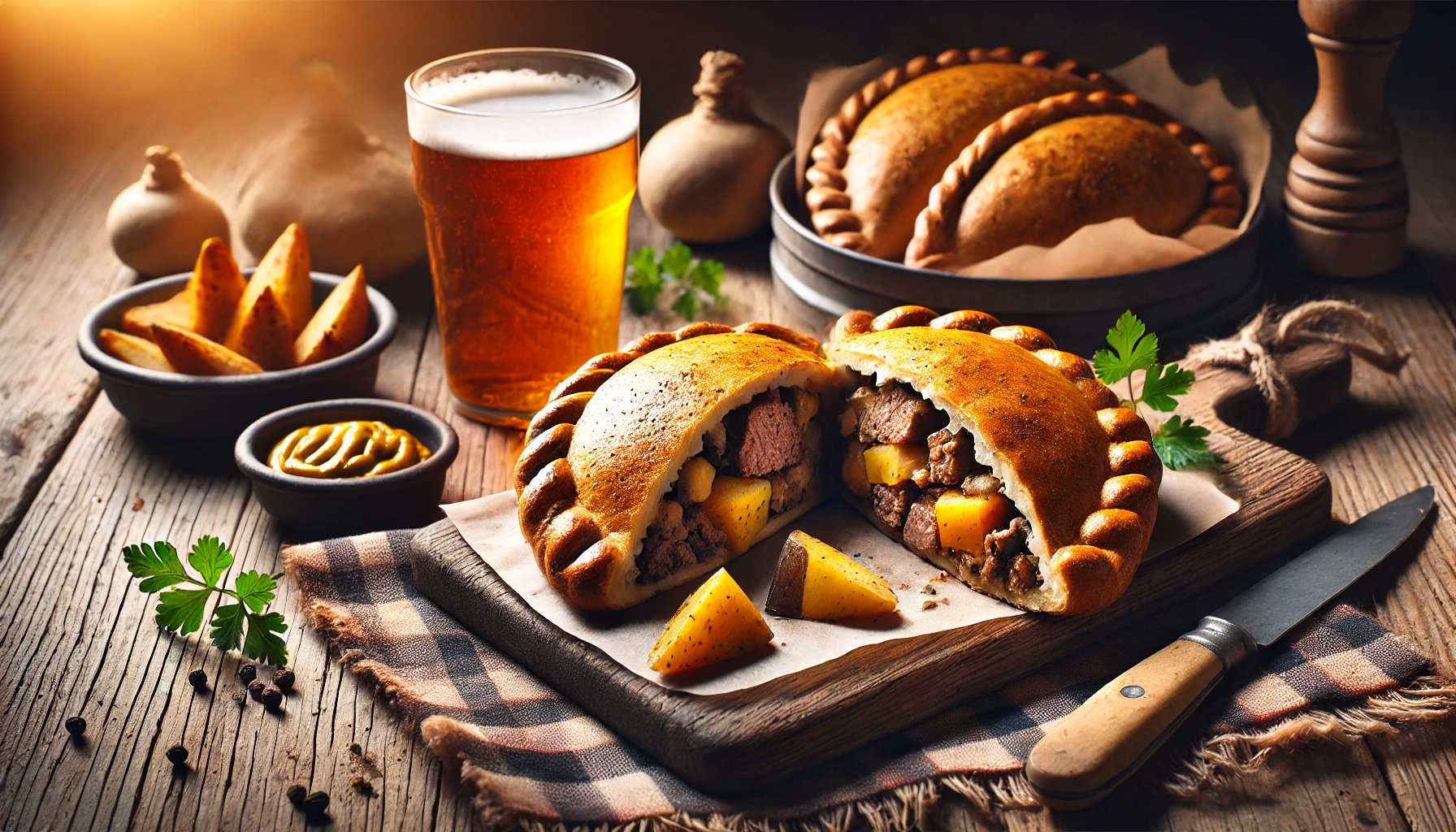
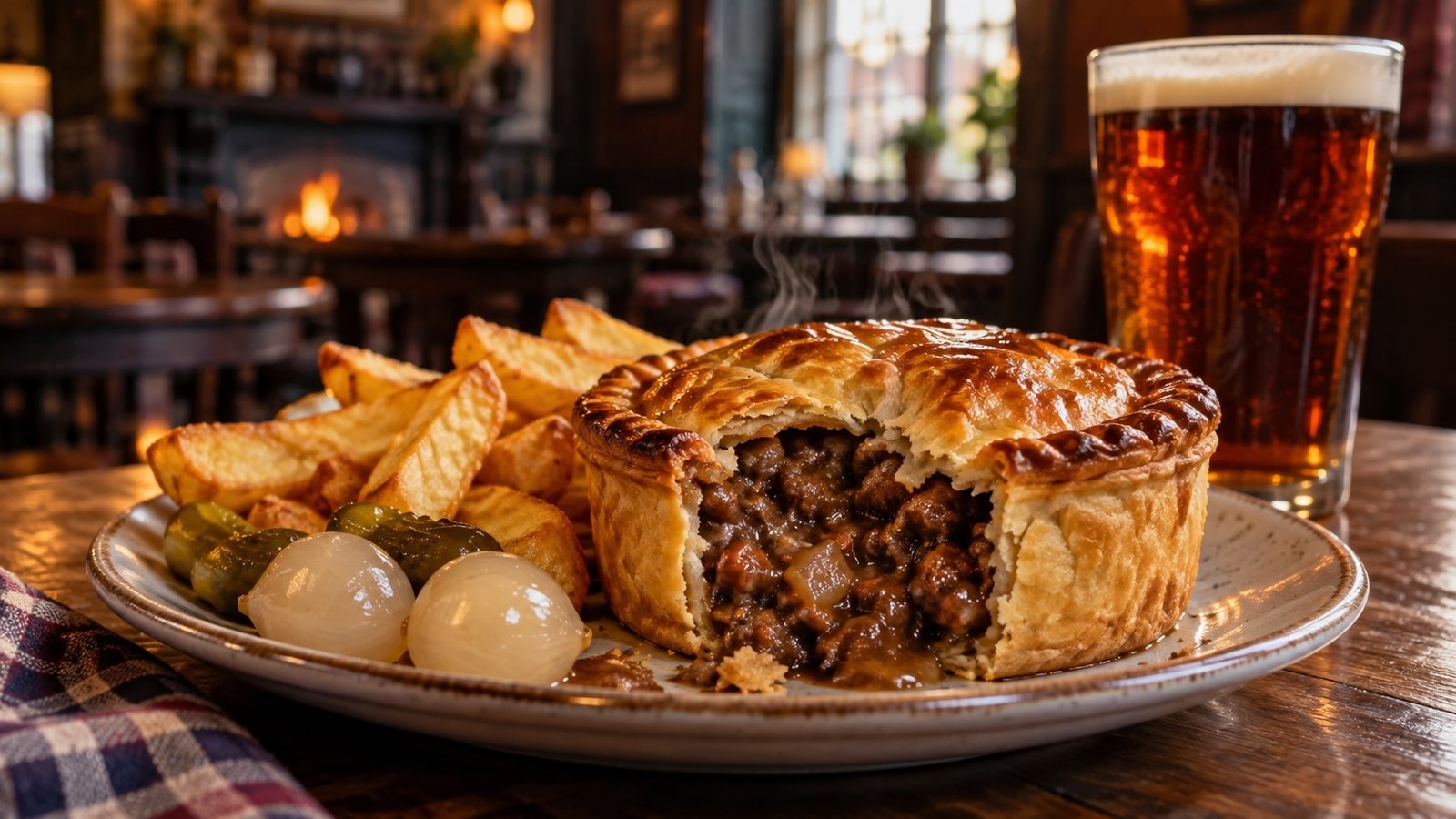
The pie itself is unusually robust. Its pastry shell is thick enough to hold the filling without a foil container. Inside sits a moist mixture traditionally based around beef, vegetables and gravy, although the precise commercial recipe remains secret. This contrast is central to the experience: firm pastry outside, soft savoury filling within.
That construction also explains the traditional eating technique. A Clarkie can be held in one hand and attacked directly. However, enthusiasm carries occupational hazards. Cardiff vocabulary reportedly includes the “Clark’s Tash”, caused by burning your upper lip on the filling. A burnt lower lip has the grander title “Hanging Gardens of Grangetown”. Haute cuisine rarely provides such useful medical terminology.
Clark’s Pie belongs to a wider British tradition of portable working food. Cornish pasties, Scotch pies and pork pies all solve roughly the same ancient problem: how do you surround something filling with pastry so a hungry person can carry it around?
Yet the Clarkie remains unmistakably Cardiff. Its importance comes partly from repetition. Generations have eaten the same sort of pie at football matches, after work and whenever carbohydrates seemed more useful than restraint. Clark’s Pies also became associated with the terraces at Ninian Park, the former home of Cardiff City.
There are regional relatives rather than strict varieties. Bristol developed its own Clark’s Pie tradition after Mary’s son Percy moved there in 1929. He eventually established production in North Street, Bedminster, where the business served workers from the nearby Wills cigarette factory.
Cardiff itself also developed different family branches, with the Clark name eventually becoming the subject of a trademark dispute. Apparently even humble meat pies can produce dynastic politics.
What makes the Clarkie special, therefore, is not exotic ingredients. Quite the opposite. It represents a disappearing category of intensely local food whose reputation was built through habit rather than marketing.
A pint of Welsh bitter or traditional British ale is perhaps its natural companion. The maltiness works beautifully with beef and gravy. A dry cider also cuts through the pastry nicely. For a non-alcoholic option, strong tea feels wonderfully appropriate. Cabernet Sauvignon may work technically, but somehow one suspects the pie would regard it with suspicion.
Chips are the obvious food companion. Mushy peas work too, while proper garden peas make the plate marginally more respectable. Pickled onions or red cabbage provide welcome acidity. Brown sauce is possible, although purists may wonder why you are interfering.
Nutritionally, Clark’s Pie belongs firmly in the category of satisfying food rather than wellness intervention. Beef provides protein, iron and vitamin B12. Vegetables can contribute fibre and micronutrients. However, pastry and gravy inevitably bring saturated fat, salt and calories.
That does not make the pie inherently “bad”. Portion size and frequency matter more than assigning moral qualities to pastry. Pairing one with vegetables rather than a mountain of chips creates a more balanced meal. Besides, nobody has ever bought a Clarkie because their fitness tracker suggested it.
For the authentic article, Cardiff remains the spiritual destination, particularly Grangetown, where the Bromsgrove Street shop has operated since 1955. Clark-related pies also have a long-established Bristol tradition. The curious traveller should remember that different businesses and family branches developed over time. The Clark’s Pie story is less a tidy corporate history than a family tree covered in pastry crumbs.
Cardiff-Style Clark’s Pie Recipe
This recipe makes six individual pies.
For the pastry, you will need 500g plain flour, 150g cold butter, 100g lard, one teaspoon salt, one egg and approximately 100ml cold water. Keep everything cold. The objective is a strong pastry case, not something so delicate that it collapses when confronted by gravy.
For the filling, use 500g beef mince, one finely chopped onion, one small grated carrot and one small finely chopped potato. Add 400ml beef stock, one tablespoon Worcestershire sauce and one teaspoon English mustard. You will also need one tablespoon plain flour, black pepper, salt and a little oil. Keep another beaten egg ready for glazing.
First, prepare the filling. Heat a little oil in a heavy frying pan and soften the onion for about five minutes. Add the beef and cook until thoroughly browned, breaking it into small pieces.
Next, stir in the carrot and potato. Sprinkle over the flour and cook briefly before gradually adding the stock. Add Worcestershire sauce and mustard, then season carefully.
Simmer gently for around 20 minutes. The mixture should become thick and cohesive rather than wet. This matters enormously. Runny filling is excellent at finding weaknesses in pastry and decorating shirts.
Allow the mixture to cool completely.
Meanwhile, make the pastry. Rub the butter and lard into the flour and salt until the mixture resembles coarse breadcrumbs. Add the egg, then enough cold water to form a firm dough.
Wrap and chill it for at least 30 minutes. Afterwards, roll it to approximately 4mm thick. Cut circles large enough to line six deep individual pie tins, keeping enough pastry for the lids.
Press the pastry firmly into each tin. Spoon in the cold beef mixture, filling generously but leaving enough space to seal the top.
Brush the edges with beaten egg. Add the pastry lids and crimp them firmly against the bases. Trim away excess pastry and make a small steam hole in each top.
Brush generously with beaten egg. Bake at 200°C, or 180°C fan, for approximately 30–35 minutes. The pies should emerge deeply golden, sturdy and distinctly substantial.
Leave them for ten minutes before eating. This is not merely culinary advice. It is preventative medicine for anyone wishing to avoid acquiring their own Clark’s Tash.
The finished pie should survive being picked up without collapsing. Bite through the firm pastry and you should reach thick, peppery beef gravy underneath. It will not be the secret Clark family recipe, of course. Cardiff has managed to keep that to itself for more than a century, and perhaps some mysteries are better left underneath a pastry lid.