Krumkake: Norway’s Delicate Christmas Treat
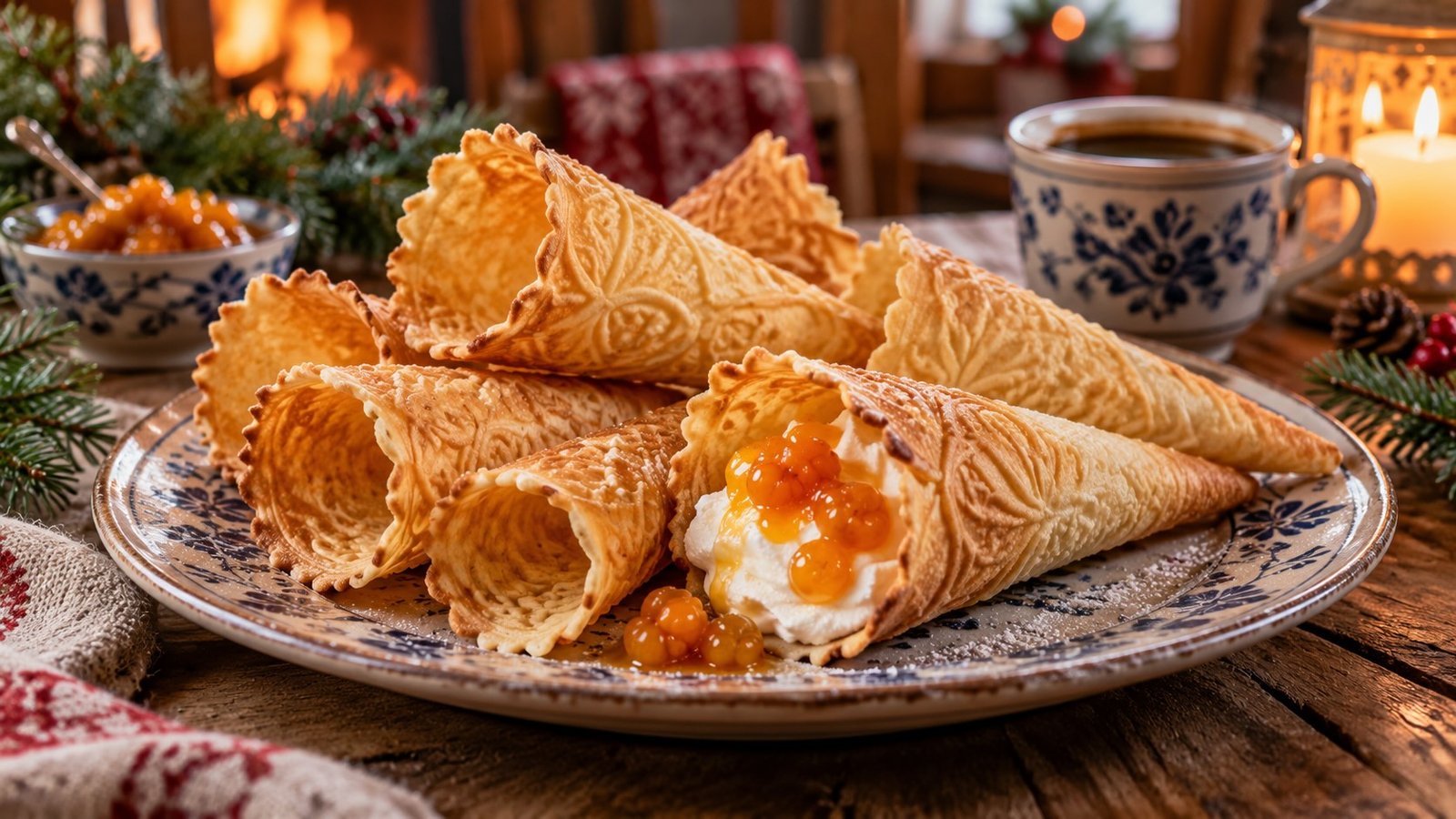
Some desserts impress with towering layers, elaborate decorations and enough chocolate to frighten a dentist. Norway’s krumkake takes a different approach. It is thin, crisp, beautifully patterned and rolled into a delicate cone. One bite produces a satisfying crackle, followed by buttery sweetness and a hint of cardamom. However, beneath its innocent appearance lies a surprisingly long history and a rather demanding relationship with timing.
Krumkake, pronounced roughly kroom-kah-keh, means ‘curved cake’ in Norwegian. Despite its name, it resembles a wafer biscuit more than a conventional cake. Bakers cook a thin batter between two decorated metal plates, then shape the warm wafer before it hardens. The result looks like an elegant ice cream cone, although it existed long before anyone thought of filling cones with frozen desserts.
The story begins in European kitchens where decorative irons had been used for centuries. Similar baking irons reached Norway from the Netherlands during the seventeenth century. Early examples carried religious symbols, reflecting their connections with communion wafers and Easter traditions. Interestingly, krumkake originally belonged more closely to Easter than Christmas. Calendar changes and evolving festive customs gradually helped it become a Christmas favourite.
By the nineteenth century, Norwegian cookbooks offered numerous krumkake recipes. Some included cream, others almonds, and a few used barley flour. There was clearly no single sacred formula. Nevertheless, krumkake eventually earned its place among Norway’s traditional syv slag, or seven varieties of Christmas biscuits. The precise selection varies between households, which gives Norwegian families something reassuringly minor to disagree about every December.
Today, krumkake remains particularly popular in Norway and Norwegian-American communities. Immigrants carried recipes and treasured baking irons to the American Midwest during the nineteenth century. Meanwhile, family traditions preserved techniques that modern kitchen gadgets have only slightly improved. Electric irons have replaced many heavy stovetop versions, but the essential ritual remains unchanged. You still have seconds to shape the wafer before it becomes stubbornly crisp.
What makes krumkake special is its remarkable texture. Unlike thicker waffles, it offers almost no resistance before shattering delicately between your teeth. The embossed surface adds visual charm, while butter creates richness without excessive heaviness. Cardamom brings a gentle citrusy, floral warmth, although vanilla also appears in many recipes. Furthermore, the thinness makes krumkake feel remarkably refined for something made from everyday cupboard ingredients.
Variations abound. Traditional cones are often served empty, allowing their crispness to shine. Others contain whipped cream and cloudberry jam, a particularly Norwegian combination. Some bakers roll them into cylinders, while others create little bowls for berries and cream. The related Norwegian biscuit strull usually takes a tubular shape and often uses an egg-free batter. Across the Atlantic, families sometimes experiment with chocolate-dipped edges or cinnamon.
As for drinks, freshly brewed coffee is perhaps krumkake’s most natural companion. Its bitterness balances the sweet, buttery wafer beautifully. Black tea with citrus also works, while hot chocolate makes a more indulgent partnership. For festive occasions, try a small glass of aquavit or a late-harvest dessert wine. However, avoid pairing heavily filled krumkake with excessively sweet drinks unless you particularly enjoy sugar competing with itself.
Food pairings offer equally attractive possibilities. Fresh raspberries, strawberries and lightly whipped cream provide refreshing contrast. Cloudberries offer a distinctive northern flavour, balancing sweetness with tartness. Alternatively, serve krumkake alongside vanilla ice cream, poached pears or a small spoonful of lemon curd. Just remember to add moist fillings immediately before serving. Otherwise, that glorious crunch quickly turns into a rather disappointing surrender.
From a nutritional perspective, krumkake has the advantage of being light and portion-sized. Eggs provide some protein, while butter contributes fat-soluble vitamins in modest amounts. However, this is still a sweet biscuit containing refined flour, sugar and saturated fat. Anyone avoiding gluten, dairy or eggs will need suitable substitutions. Fortunately, its delicate character means one or two biscuits can feel satisfying, especially when accompanied by fresh fruit.
Perhaps krumkake’s greatest charm is the ritual itself. Making it requires patience, quick fingers and occasional negotiations with a hot baking iron. Yet those fragile golden cones carry centuries of history into the modern kitchen. They remind us that festive food need not be extravagant to feel special. Sometimes, all it takes is a little butter, an old family recipe and the ability to roll a biscuit before it wins the argument.
Recipe: Traditional Norwegian Krumkake
Makes 20–24 krumkake | Preparation: 15 minutes | Resting: 20 minutes | Cooking: 30–40 minutes
This traditional-style recipe produces delicate, buttery wafers with a subtle cardamom flavour. You will need a krumkake iron and a wooden or heat-resistant cone roller.
Ingredients
- 2 large eggs
- 120g caster sugar
- 120g unsalted butter, melted and cooled
- 120g plain flour
- ½ teaspoon ground cardamom
- ½ teaspoon vanilla extract (optional)
- 2–3 tablespoons water, if needed
- A pinch of salt
Optional filling
- 200ml double cream
- 1 tablespoon icing sugar
- ½ teaspoon vanilla extract
- 100g cloudberry jam or raspberry jam
- Fresh berries for serving
Method
Beat the eggs and sugar together until pale, thick and slightly fluffy. Gradually stir in the melted butter, followed by the vanilla extract if using. Meanwhile, combine the flour, cardamom and salt in a separate bowl.
Fold the dry ingredients into the egg mixture until you have a smooth batter. It should resemble thick pancake batter. Add a little water if necessary, then leave it to rest for approximately 20 minutes.
Preheat your krumkake iron according to its instructions. Lightly grease the plates if required, then place approximately one tablespoon of batter in the centre. Close the iron and cook for 30–60 seconds, depending on the appliance. The wafer should emerge evenly golden with a delicate embossed pattern.
Immediately lift the hot wafer using a heat-resistant spatula. Wrap it around your cone roller while it remains flexible. Hold briefly until the shape sets, then transfer it to a wire rack. Work carefully, because the wafers are extremely hot and become brittle within seconds.
Continue until you have used all the batter. Allow the cones to cool completely before storing them in an airtight container. They should remain crisp for several days if protected from moisture.
For the filling, whip the double cream with icing sugar and vanilla until soft peaks form. Spoon a little jam into each cone, then pipe in the whipped cream. Finish with fresh berries and serve immediately.
A final tip: For maximum crispness, leave the cones unfilled until the last possible moment. Norwegian grandmothers have been protecting their biscuits from moisture for generations, and there is little reason to challenge their wisdom.
1 comment