Bündner Nusstorte: The Swiss Walnut Tart with a Caramel Secret
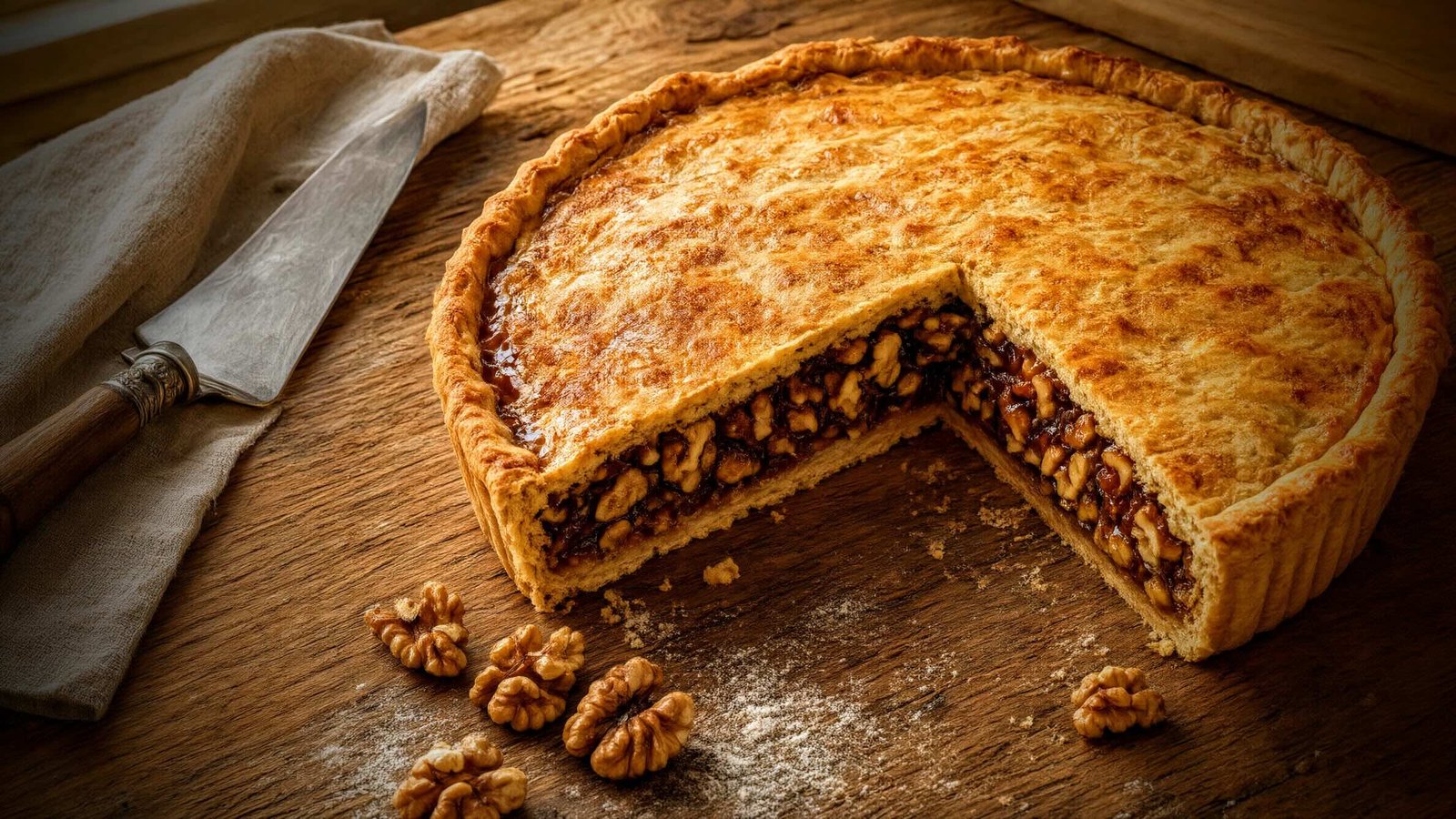
There are cakes that look spectacular but taste rather ordinary. Then there is Bündner Nusstorte, a modest Swiss walnut tart that looks almost suspiciously plain. Beneath its golden pastry lies a generous filling of walnuts and caramel, rich enough to make a mountain climber reconsider the benefits of exercise.
This traditional speciality comes from Graubünden, Switzerland’s largest canton, where dramatic Alpine landscapes meet a remarkably sophisticated baking tradition. Known locally as Engadiner Nusstorte or Tuorta da nusch, it has become one of the region’s most recognisable culinary exports. And unlike many fashionable desserts, it has never needed chocolate fountains, edible flowers or architectural ambitions.
The story begins in the Engadin valley, a region famous for its mountains, elegant villages and centuries-old tradition of confectionery. During the eighteenth and nineteenth centuries, many people from Graubünden travelled abroad to work as pastry chefs and confectioners. They established successful businesses in cities across Europe, particularly in Italy, France and Austria. Consequently, these travelling bakers brought home techniques and recipes that gradually enriched their local cuisine.
The modern walnut tart emerged from this exchange of culinary ideas. Although earlier nut-based pastries existed, the caramel-filled version gained prominence during the twentieth century. One frequently cited figure is Fausto Pult, a confectioner from Samedan who helped popularise the cake in the 1920s and 1930s. However, assigning its invention to one baker would oversimplify a much longer regional tradition.
There is also a delightful geographical contradiction. Graubünden’s high Alpine valleys are hardly ideal walnut-growing country. Historically, bakers obtained many of their walnuts through trade with warmer regions, including Italy. So, one of Switzerland’s most famous regional cakes owes its distinctive character partly to ingredients from elsewhere. Culinary nationalism has always been more flexible than its political equivalent.
What makes Bündner Nusstorte special is the relationship between three simple components: buttery pastry, toasted walnuts and caramel. The pastry forms a firm, slightly crumbly shell that protects the filling. Inside, the walnuts provide an earthy bitterness that balances the sweetness of the caramel. Meanwhile, cream gives the mixture a softer, richer consistency without turning it into a conventional custard.
Unlike an American pecan pie, Bündner Nusstorte contains no egg-based filling. Its interior is denser, less gelatinous and distinctly chewy. Moreover, the walnuts remain the main attraction rather than becoming decorative passengers in a sea of sugar.
The cake also has an impressive practical advantage: it keeps exceptionally well. Its enclosed filling and relatively low moisture content help preserve its flavour and texture for several days. In fact, many enthusiasts believe it tastes better after resting overnight. This makes it an excellent travelling companion, although whether it survives an entire train journey depends on the passenger.
Regional variations naturally exist. Some bakers prefer a thinner pastry shell and a particularly generous walnut filling. Others produce a thicker, more biscuit-like crust. Certain recipes include honey, while others rely entirely on caramelised sugar. A little lemon zest occasionally appears in the pastry, adding freshness to an otherwise unapologetically rich dessert.
There are also miniature Nusstorten, which solve the problem of portion control by making it possible to eat three instead of one. Commercial bakeries sometimes experiment with chocolate or alternative nuts. Nevertheless, traditionalists generally favour the classic combination of walnuts, sugar, cream and pastry.
In Graubünden, the cake often appears in cafés alongside coffee or tea. However, it also makes a wonderful dessert after a hearty Alpine meal. A small slice provides a satisfying finish to dishes such as capuns, the region’s traditional Swiss chard parcels, or a plate of Bündnerfleisch, the famous air-dried beef.
For a lighter combination, serve Nusstorte with fresh raspberries, poached pears or a spoonful of unsweetened whipped cream. The fruit adds acidity, while the cream softens the caramel’s intensity. Vanilla ice cream works beautifully too, particularly when the tart is slightly warm. Just remember that the cake hardly qualifies as a light refreshment before the ice cream arrives.
Drinks deserve careful consideration. Strong espresso is perhaps the most natural partner, as its bitterness contrasts with the sweet filling. A smooth cappuccino also works well, especially during a leisurely afternoon in an Alpine café. Alternatively, black tea offers a less intense but equally pleasant pairing.
Wine lovers might try a small glass of late-harvest Riesling or another dessert wine with good acidity. For something more regional, a Swiss Pinot Noir can provide an interesting contrast, although it is not the most conventional pairing. Meanwhile, a modest measure of walnut liqueur turns the experience into a celebration of the cake’s central ingredient.
Nutritionally, Bündner Nusstorte offers a mixture of genuine benefits and rather obvious indulgences. Walnuts contain unsaturated fats, including plant-based omega-3 fatty acids, alongside fibre, minerals and antioxidants. These nutrients can support cardiovascular health when walnuts form part of a balanced diet.
Unfortunately, caramel does not become a health food simply because it shares a pastry case with walnuts. Traditional Nusstorte contains substantial amounts of sugar, butter and cream. Consequently, it is energy-dense, and a relatively small slice can deliver a considerable number of calories. People with tree-nut allergies must avoid it entirely.
Still, dessert does not need to justify its existence as a nutritional supplement. A modest slice enjoyed occasionally is perfectly compatible with a varied diet. Besides, the Swiss have managed to combine excellent chocolate, rich pastries and spectacular mountain scenery without suggesting that everyone should survive exclusively on steamed vegetables.
Finding authentic Bündner Nusstorte is easiest in Graubünden itself. Bakeries in St Moritz, Samedan, Pontresina, Chur and other regional towns frequently offer their own versions. Some establishments still prepare the cake using recipes passed down through generations. Elsewhere in Switzerland, specialist confectioners and delicatessens often stock it, particularly during the winter holiday season.
Outside Switzerland, availability becomes less predictable. Specialist Swiss food shops and online retailers occasionally sell imported versions. However, the cake’s excellent keeping qualities make it particularly suitable for shipping. Naturally, homemade Nusstorte offers another advantage: you can decide exactly how generous the walnut filling should be.
Ultimately, Bündner Nusstorte captures something appealing about traditional Alpine cooking. It transforms a handful of ordinary ingredients into something memorable through technique, patience and a healthy disregard for fashionable restraint. Its exterior promises very little, while its interior delivers considerably more. Perhaps that is why it has survived generations of changing tastes without needing a redesign.
Recipe: Traditional Bündner Nusstorte
1 hour 20 minutes, plus chilling
Serves 10–12
23 cm round tin
This recipe produces a traditional walnut tart with crisp, buttery pastry and a rich caramel filling. Allow the finished cake to rest overnight for the best flavour and texture.
Ingredients for the pastry
- 300 g plain flour
- 150 g cold unsalted butter, cubed
- 120 g caster sugar
- 1 large egg
- 1 pinch of salt
- 1–2 tablespoons cold water, if needed
Ingredients for the filling
- 250 g walnut halves, roughly chopped
- 200 g caster sugar
- 200 ml double cream, gently warmed
- 30 g unsalted butter
- 1 tablespoon honey (optional)
- 1 pinch of salt
For finishing
- 1 egg yolk
- 1 tablespoon milk
Preparing the pastry
Combine the flour, sugar and salt in a large mixing bowl. Rub in the cold butter until the mixture resembles coarse breadcrumbs. Add the egg and bring everything together into a smooth dough. If necessary, add a little cold water.
Divide the dough into two portions, making one slightly larger than the other. Flatten both into discs, wrap and refrigerate for at least 30 minutes.
Making the walnut caramel
Place the sugar in a heavy-bottomed saucepan over medium heat. Allow it to melt gradually, swirling the pan occasionally, until it develops a deep amber colour. Avoid stirring unnecessarily, as this can encourage crystallisation.
Carefully add the warmed cream in small amounts. The mixture will bubble vigorously, so keep your hands clear of the steam. Stir over low heat until the caramel becomes smooth again.
Add the butter, salt and optional honey. Then fold in the chopped walnuts, ensuring every piece receives a generous coating. Remove the saucepan from the heat and allow the filling to cool until warm rather than hot.
Assembling the tart
Preheat the oven to 180°C, or 160°C fan. Grease a 23 cm round cake tin, preferably one with a removable base.
Roll out the larger pastry portion and line the base and sides of the tin. Aim for pastry approximately 3–4 mm thick, leaving enough height to contain the filling.
Spread the cooled walnut caramel evenly inside. Next, roll out the remaining pastry to form a lid. Place it over the filling, press the edges together and trim away any excess dough.
Brush the surface with egg yolk mixed with milk. Prick several small holes in the lid to allow steam to escape.
Baking and serving
Bake for 35–45 minutes until the pastry turns a rich golden brown. If the surface colours too quickly, cover it loosely with foil.
Leave the tart in its tin until completely cool. Ideally, refrigerate it overnight, then bring it back to room temperature before serving. Cut into relatively thin wedges using a sharp knife.
Store in an airtight container in a cool place for several days, or refrigerate for longer storage. Serve with strong coffee, lightly whipped cream or simply on its own. The caramel and walnuts already provide more than enough entertainment.