The Sweet Secret of Medovník: Czech Honey Cake
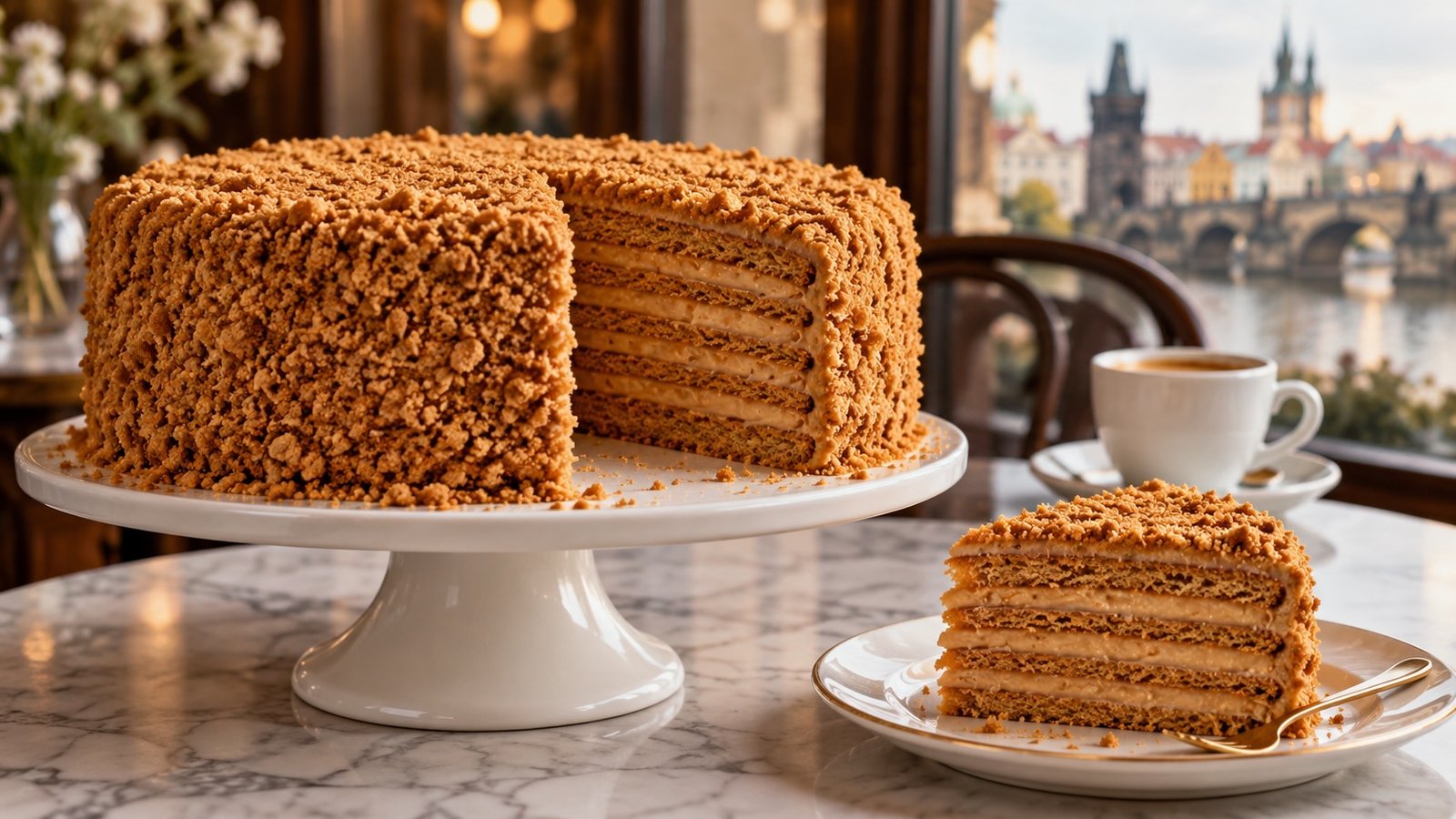
Some cakes demand immediate attention. They emerge from the oven, fill the kitchen with irresistible aromas and insist you eat them before they cool. Medovník, the famous Czech honey cake, takes a different approach. It asks you to wait, preferably overnight, while its layers quietly transform into something extraordinary.
This beautiful cake consists of thin honey-flavoured sponge layers, rich cream filling and a generous coating of golden crumbs. At first glance, it resembles an elaborate architectural project. However, beneath its impressive appearance lies a surprisingly simple idea: honey, flour, butter and cream, given enough time to become thoroughly acquainted.
Medovník has become a familiar sight in Czech cafés, where generous slices accompany strong coffee and lengthy conversations. Yet its history reaches beyond the Czech Republic. Honey cakes have existed across Central and Eastern Europe for centuries, long before refined sugar became affordable. Honey was both a valuable sweetener and a symbol of prosperity, making honey-based pastries particularly suitable for celebrations.
The modern layered version belongs to a broader family of honey cakes found throughout the region. Russian medovik, Ukrainian honey cakes and various Central European interpretations share similar ingredients and techniques. However, the Czech version developed its own identity, particularly through the popularity of commercially produced Medovník cakes during the 1990s.
One of the best-known Czech commercial versions emerged through Armenian-born entrepreneur Gevorg Avetisjan, who helped popularise the cake in the Czech Republic. This connection reflects the dessert’s wonderfully complicated culinary ancestry. Like many European specialities, Medovník has travelled, borrowed ideas and acquired several national identities along the way.
What makes Medovník special is its transformation after assembly. Initially, the baked layers can seem rather firm and unpromising. However, the cream gradually penetrates them, producing a wonderfully soft texture without destroying their delicate structure. After a day in the refrigerator, the cake becomes tender, moist and remarkably harmonious.
Traditional recipes vary considerably. Some use sour cream, while others favour buttercream enriched with caramelised condensed milk. Certain versions combine both, balancing sweetness with gentle acidity. Walnuts occasionally appear between the layers or in the crumb coating, adding a pleasant contrast to the cake’s smooth interior.
The choice of honey also matters. Mild blossom honey produces a delicate sweetness, while darker varieties introduce deeper, almost malty flavours. Nevertheless, extremely strong honey can overwhelm the cream, so moderation is advisable. This is one occasion when the most expensive ingredient isn’t necessarily the best.
Across the Czech Republic, Medovník appears in different shapes and sizes. Round cakes remain particularly popular, although rectangular versions make portioning easier. Some bakers produce six thin layers, while others build impressive towers of eight or more. Meanwhile, chocolate decorations, chopped nuts and caramel cream offer opportunities for personal interpretation.
Coffee is Medovník’s natural companion. A strong espresso provides welcome bitterness against the honey and caramel, while a cappuccino offers a gentler pairing. Black tea also works beautifully, especially varieties with malty notes. For something more celebratory, consider a small glass of Czech dessert wine or a moderately sweet Tokaji.
When serving Medovník, simplicity usually wins. Fresh raspberries, redcurrants or strawberries introduce acidity that balances its richness. Alternatively, a spoonful of unsweetened crème fraîche provides a refreshing contrast. A fruit compote also works, although heavily sweetened accompaniments risk turning dessert into a sugar competition.
Honey contains small amounts of antioxidants and other naturally occurring compounds. Walnuts, when included, contribute unsaturated fats and useful minerals. However, Medovník remains a rich dessert containing substantial quantities of sugar, butter and cream. Its nutritional advantages are therefore modest, and sensible portions make more sense than heroic claims about honey’s medicinal properties.
Fortunately, Medovník has one genuinely practical advantage: it improves with patience. You can prepare it a day or two before entertaining, leaving the refrigerator to perform the final magic. And unlike many delicate pastries, it generally slices beautifully once properly chilled.
Recipe: Traditional Czech Medovník Honey Cake
1 hour preparation
25–35 minutes baking
12–24 hours chilling
Makes 10–12 slices | 20 cm round cake
Ingredients for the honey layers
- 450 g plain flour, plus extra for rolling
- 150 g caster sugar
- 100 g unsalted butter
- 100 g runny honey
- 2 large eggs
- 1 teaspoon bicarbonate of soda
- A pinch of salt
Ingredients for the cream filling
- 400 g full-fat sour cream
- 250 g unsalted butter, softened
- 300 g caramelised condensed milk (dulce de leche)
- 1 teaspoon vanilla extract
- 75 g finely chopped walnuts (optional)
Preparing the honey dough
Place the butter, honey and sugar in a heatproof bowl over a saucepan of gently simmering water. Stir until everything melts into a smooth mixture. Remove from the heat and allow it to cool slightly before whisking in the eggs.
Add the bicarbonate of soda and salt, then gradually incorporate the flour. Mix until a soft, slightly sticky dough forms. Divide it into six equal portions and keep them covered while you work.
Baking the layers
Preheat the oven to 180°C (160°C fan). Roll each portion of dough between sheets of baking parchment into a thin circle, approximately 22 cm across. Remove the top sheet and bake each layer for 4–6 minutes until golden brown.
While the layers remain warm, trim them into neat 20 cm circles using a plate or cake ring. Reserve all the trimmings for decoration. Allow the layers to cool completely on wire racks.
Making the cream
Beat the softened butter until pale and fluffy. Gradually incorporate the caramelised condensed milk, followed by the vanilla extract. Separately, stir the sour cream until smooth.
Fold the sour cream into the butter mixture in several additions. The ingredients should be at similar temperatures to prevent splitting. The finished filling should be smooth, creamy and easy to spread.
Assembling the cake
Place the first honey layer on a serving plate and spread a generous portion of cream over it. Repeat with the remaining layers, pressing gently to maintain an even structure. Cover the top and sides with the remaining cream.
Crush the reserved pastry trimmings into fine crumbs using a food processor. Mix with the chopped walnuts, if using. Then press the mixture over the top and sides until the entire cake has a beautiful golden coating.
The essential waiting period
Refrigerate the assembled cake for at least 12 hours, preferably 24. During this time, the cream softens the honey layers and creates Medovník’s characteristic tender texture.
Remove the cake from the refrigerator about 20 minutes before serving. Cut into generous slices with a sharp knife, wiping the blade between cuts.
The result is a beautifully layered cake with a delicate honey aroma, creamy caramel filling and gently nutty finish. Serve with strong coffee, invite a few friends and enjoy a Czech speciality that rewards patience rather better than most things in life.
Post Comment