Bolo de Banana – Overripe Bananas, Perfect Cake
Bolo de banana begins, more often than not, with neglect. A few bananas sit on the counter too long, their skins darken, and their texture turns suspiciously soft. Suddenly, the household faces a small moral test: waste them, or turn them into something better than they ever were in their respectable yellow phase. In Brazil, the answer is obvious. This is how an ordinary afternoon acquires the smell of caramel, butter, and cinnamon. As a result, a humble fruit stages an unexpectedly successful comeback.
Banana cake has a long, meandering history that does not belong to a single country, yet Brazil has made it particularly its own. The roots stretch back into the broader story of sugar, tropical agriculture, and colonial kitchens. In those kitchens, ingredients were abundant but techniques were often improvised. Bananas, brought across oceans and cultivated enthusiastically, became one of the most accessible fruits. Because they required little effort to grow, they slipped naturally into everyday cooking. Over time, they were mashed into porridges, fried in butter, layered into desserts, and eventually folded into cakes that required little precision.
The Brazilian version of banana cake evolved in a way that feels distinctly practical. It is not a dessert obsessed with structure or perfection. Instead, it is forgiving, adaptable, and deeply tied to daily life. You will find it in family kitchens, school lunchboxes, and small bakeries. Although it sits beside stronger personalities like chocolate cakes, it rarely competes. Rather, it simply persists.
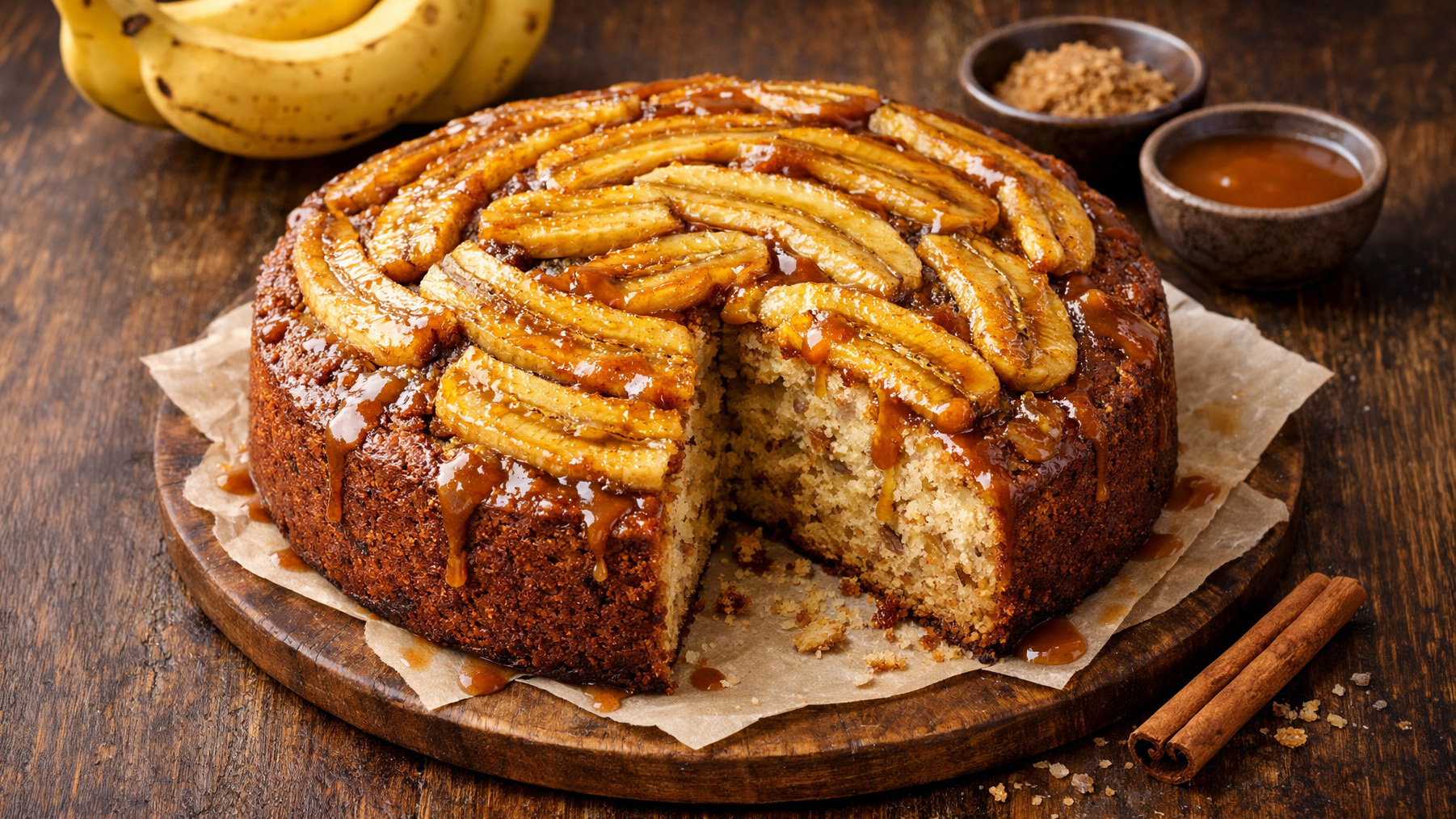
Regional variations are where things become interesting. In the south of Brazil, where European influences are stronger, bolo de banana sometimes leans closer to a classic sponge. Consequently, it becomes lighter and more structured. Occasionally, a caramelised topping turns the cake upside down in a theatrical flourish. Further north, the cake grows denser and more rustic. Here, cassava flour or oats may replace part of the wheat flour. Meanwhile, spices such as cinnamon and clove begin to assert themselves.
In some versions, slices of banana are layered generously throughout. As a result, pockets of soft sweetness form within the cake. In other versions, the bananas are fully mashed into the batter. This creates a smoother texture, where the fruit becomes less visible but more essential. Either way, the banana remains firmly in control.
There is also a variation that dispenses with flour almost entirely. Instead, oats or even breadcrumbs take over. At first glance, it sounds like a compromise. However, the result is surprisingly indulgent. At the same time, it carries a faint sense of virtue, which many modern desserts attempt but rarely achieve.
What makes bolo de banana special is not complexity. On the contrary, it is defined by simplicity. It absorbs imperfection and turns it into flavour. Overripe bananas, unwelcome elsewhere, are exactly what this cake demands. Because their sweetness is intensified, they provide depth. Sugar shapes the flavour rather than dominating it. Meanwhile, butter adds richness and eggs provide structure.
The texture sits somewhere between cake and pudding. It is soft without being fragile, and moist without becoming heavy. As a result, it feels appropriate at almost any hour. Served warm, it leans towards comfort food. When cooled, it becomes something you slice casually, often pretending restraint.
Coffee is the obvious companion. In Brazil, the ritual of café da tarde makes that pairing almost inevitable. A strong, slightly bitter coffee balances the sweetness. For a different approach, a glass of cold milk works beautifully. Especially with a denser cake, it adds contrast. If you want to push things further, a small glass of aged rum or cachaça works surprisingly well.
As for complementary foods, bolo de banana is sociable but not demanding. A spoonful of cream or a scoop of vanilla ice cream turns it into a more deliberate dessert. Additionally, a drizzle of honey or toasted nuts adds texture. Yet it is equally happy standing alone, which may be its most appealing quality.
There is also a quiet argument about its nutritional virtues. Bananas bring potassium, fibre, and natural sugars. If oats are included, there is added slow-releasing energy. In that sense, it is more wholesome than many desserts. However, it remains a cake. Butter and sugar still play their roles. Therefore, moderation remains a sensible idea, even if it is rarely followed.
Finding bolo de banana outside Brazil is not difficult. However, finding a truly good one can be more challenging. In the UK, Brazilian cafés in cities like London often offer it. Alongside pão de queijo and brigadeiros, it holds its place quietly. Some independent bakeries have adapted their own versions. Although these may resemble banana bread, the difference matters.
A proper bolo de banana should feel softer and richer. Banana bread, by contrast, often behaves as though it is trying to be healthy. That distinction, while subtle, is important.
Ultimately, the best place to encounter it is at home. Not because it is rare elsewhere, but because making it carries a particular satisfaction. It is quick, forgiving, and difficult to ruin. Even a slightly overbaked version retains charm.
Bolo de banana Recipe
Start with three to four very ripe bananas. The kind that look past their best yet are quietly at their peak. Mash them in a bowl until mostly smooth. A few small lumps are perfectly acceptable.
In a separate bowl, beat two eggs with about 150 grams of sugar. Continue until the mixture becomes slightly pale. Then add 100 grams of melted butter and mix well. Stir in the mashed bananas, allowing everything to combine evenly.
Next, add 200 grams of flour, a teaspoon of baking powder, and a pinch of salt. If desired, include a teaspoon of cinnamon. Fold the mixture gently. Overmixing should be avoided, as it affects the texture.
For a more traditional touch, line the baking tin with sliced bananas and a light layer of sugar. As it bakes, this will caramelise into a topping.
Pour the batter into a greased tin. Bake at 180°C for around 35 to 45 minutes. The top should turn golden, and a knife inserted into the centre should come out mostly clean.
Finally, allow it to cool slightly before removing from the tin. Alternatively, serve it warm. Either way, pair it with coffee and expect it to disappear quickly.